Mechanized Marvels: A Complete Guide to Hydraulic Presses and Modern Manufacturing
Industrial machines are the backbone of modern manufacturing. From forging and stamping to assembly and finishing, these machines automate complex processes with high precision and consistency. Among them, hydraulic presses stand out as one of the most versatile and powerful tools in production environments
A hydraulic press uses fluid pressure to generate a compressive force, making it ideal for shaping, forming, and molding metal or composite materials. This simple principle, introduced in the 18th century, has evolved into highly advanced, programmable systems central to industrial automation.
Today, mechanization is no longer limited to large factories — even small and medium manufacturers use automated systems to enhance speed, safety, and quality.
Importance — Why Industrial Machines Matter
Industrial machines such as hydraulic presses, CNC systems, and robotic arms are transforming how industries operate. Their impact includes:
-
Precision and Repeatability: Machines ensure identical results across thousands of production cycles.
-
Higher Productivity: Automation significantly reduces processing time and human fatigue.
-
Material Efficiency: Machines optimize material usage through controlled pressure and temperature.
-
Safety and Ergonomics: Operators face fewer hazards as machines perform heavy or dangerous tasks.
-
Scalability: Modular machinery adapts to changing production volumes and product types.
These advantages have reshaped global supply chains — making manufacturing faster, more flexible, and sustainable.
Recent Updates and Trends (2024–2025)
The last few years have witnessed remarkable innovation in industrial machinery, especially in the field of hydraulic systems, robotics, and automation.
| Trend | Description | Impact |
|---|---|---|
| Smart Hydraulic Systems | Integration of sensors for real-time pressure and temperature monitoring. | Improves precision and predictive maintenance. |
| AI-Controlled Machines | Artificial intelligence optimizes motion control and energy usage. | Enhances process efficiency and reduces downtime. |
| Hybrid Press Technologies | Combination of hydraulic and mechanical presses. | Provides faster operation with energy savings. |
| Additive Manufacturing Integration | Machines collaborate with 3D printing systems. | Expands flexibility for prototyping and tooling. |
| Sustainability and Energy Efficiency | Development of oil-free, eco-friendly hydraulic fluids. | Reduces environmental footprint and waste. |
According to a 2025 industry report, digital twins and IoT-based monitoring have become key tools for suppliers, enabling remote diagnostics and lifecycle management of machinery.
Laws and Industrial Regulations
The operation and production of industrial machines, including hydraulic presses, are regulated to ensure worker safety, energy efficiency, and environmental compliance.
In India, standards are governed by:
-
Bureau of Indian Standards (BIS): Regulates design and safety codes for industrial machinery.
-
Factories Act, 1948: Outlines operator safety, machine guarding, and maintenance protocols.
-
Energy Conservation Act, 2001: Encourages adoption of energy-efficient manufacturing technologies.
Globally, compliance with ISO standards such as ISO 4413:2010 (hydraulic fluid power safety) and ISO 9001 (quality management systems) ensures operational reliability and uniform manufacturing practices across suppliers.
Tools, Systems, and Resources in Modern Mechanized Manufacturing
Manufacturers and engineers use a variety of software, monitoring systems, and digital tools to design, analyze, and optimize industrial machinery.
| Tool / Resource | Purpose | Example Use Case |
|---|---|---|
| CAD / CAM Software | 3D modeling and manufacturing process design | SolidWorks, AutoCAD, CATIA |
| Finite Element Analysis (FEA) | Simulates mechanical stress and load distribution | Used in press design and tooling optimization |
| SCADA Systems | Supervisory control and data acquisition | Monitors performance and energy consumption |
| PLC Controllers | Automation of mechanical operations | Controls motion sequences and pressure regulation |
| IoT Dashboards | Remote data analytics and predictive maintenance | Tracks oil temperature, flow rate, and component wear |
| ERP Integration | Production planning and supplier coordination | Streamlines workflows across departments |
These technologies collectively form the foundation of smart factories, where data-driven insights lead to continuous improvement and cost efficiency.
Core Types of Industrial Machines in Modern Manufacturing
Industrial manufacturing employs a wide range of machines designed for specific processes:
1. Hydraulic Presses
-
Use Pascal’s Law to apply force through hydraulic fluid.
-
Common in forging, molding, and powder compaction.
-
Offer high tonnage and precise pressure control.
2. CNC Machines
-
Computer Numerical Control systems automate cutting, drilling, and shaping operations.
-
Capable of micrometer-level accuracy.
3. Injection Moulding Machines
-
Melt and inject plastic into molds for large-scale component production.
-
Used in automotive, consumer goods, and medical industries.
4. Robotic Arms
-
Perform repetitive tasks like welding, painting, and assembly.
-
Improve consistency and reduce human intervention.
5. Conveyors and Material Handling Systems
-
Move materials efficiently between production stages.
-
Often equipped with sensors for automated routing.
6. Industrial Mixers and Extruders
-
Used in chemical and food processing for blending and forming operations.
Together, these machines create a synchronized network that defines Industry 4.0 manufacturing.
Hydraulic Presses — The Heart of Heavy-Duty Manufacturing
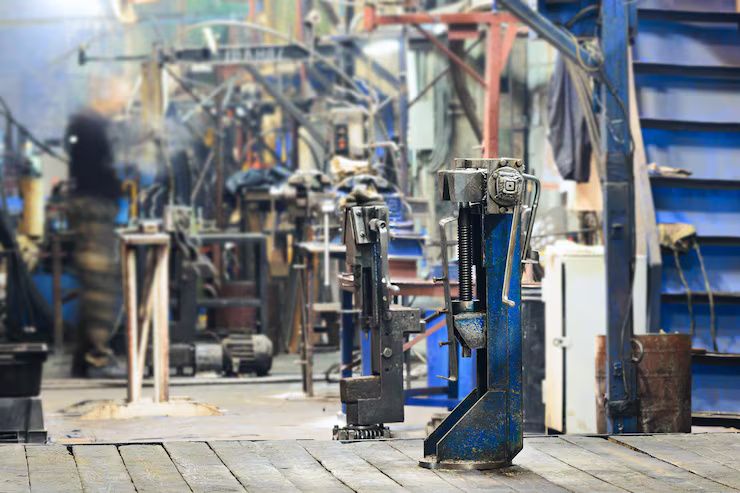
Hydraulic presses remain indispensable in industries where high pressure and precision are critical.
Key components include:
-
Hydraulic cylinder
-
Pump and motor system
-
Control valves
-
Pressure gauge and reservoir
Applications:
-
Metal forming and forging
-
Car body panel manufacturing
-
Ceramic and composite material molding
-
Waste compaction and recycling processes
Advantages:
-
Uniform pressure application
-
High force output with compact design
-
Flexible operation for multiple materials
-
Quieter performance compared to mechanical presses
As industries aim for sustainability, servo-hydraulic presses — combining electric and hydraulic systems — are gaining traction for their energy efficiency and precise control.
Industrial Suppliers and Ecosystem
The supplier ecosystem for industrial machines includes:
-
Component Manufacturers: Pumps, valves, actuators, and control systems.
-
System Integrators: Combine machines into automated production lines.
-
Maintenance Providers: Offer calibration, testing, and performance audits.
-
Digital Solution Providers: Deliver IoT dashboards and data analytics tools.
Suppliers now emphasize lifecycle services — from installation and remote monitoring to retrofitting and software upgrades — enabling longer machine life and reduced environmental impact.
Challenges in Mechanized Manufacturing
| Challenge | Description | Solution |
|---|---|---|
| Energy Consumption | High hydraulic power usage | Introduce variable-speed drives and smart pumps |
| Maintenance Downtime | Wear and tear of moving parts | Predictive maintenance via IoT analytics |
| System Calibration | Pressure and alignment errors | Routine inspection and digital calibration tools |
| Operator Safety | Risk of mechanical failure | Sensor-based emergency shutoff systems |
| Supply Chain Complexity | Coordination among multiple suppliers | Integrated ERP and vendor management systems |
Addressing these challenges improves uptime and sustainability.
Frequently Asked Questions (FAQs)
1. What is a hydraulic press used for?
A hydraulic press uses fluid pressure to form, mold, or compress materials — commonly used in metalworking, automotive, and packaging industries.
2. How do hydraulic presses differ from mechanical presses?
Hydraulic presses apply constant force throughout the stroke, while mechanical presses deliver peak force near the bottom of the stroke.
3. What industries rely most on mechanized manufacturing?
Automotive, aerospace, electronics, and construction sectors depend heavily on industrial machines for efficiency and accuracy.
4. Are smart factories replacing traditional machines?
Not entirely — instead, traditional machines are being upgraded with sensors and digital controls to create hybrid intelligent systems.
5. How can suppliers adapt to automation trends?
Suppliers can invest in IoT-ready machinery, predictive analytics, and sustainable materials to stay competitive in global markets.
Conclusion
Industrial machines like hydraulic presses have become mechanized marvels of modern manufacturing, combining mechanical power with digital intelligence.
They enable industries to produce faster, safer, and more sustainably than ever before. With ongoing innovations in automation, AI, and energy management, these machines are not just tools — they are the driving force behind the next generation of smart, connected factories.